A living room shelf does two jobs: it gives plants light and air, and it turns a blank wall into the most interesting part of the room.
Most living rooms already have a shelf spot – in front of a window, in an empty corner, above a sofa, or on a dark wall. The six ideas below cover those spots, with the plants that suit each one.
First, a short basics section. Most shelf failures are weight, anchor, and light failures, and all three are easy to avoid.
Quick Answer
Start with a shelf anchored for the real weight of wet soil and ceramic pots, then measure the light at the shelf position itself, not at the window. The most reliable living room setups are a slim shelf in front of a bright window for light-hungry plants, floating shelves in an empty corner, and a picture-ledge row for small pots and trailing plants.
In This Post
- Before you hang anything: shelf basics
- 1. The window-front shelf
- 2. Floating shelves in a blank corner
- 3. The shelf above the sofa – safely
- 4. Ladder shelf / leaning bookcase
- 5. One long picture-ledge plant row
- 6. Shelf with a grow light for a dark wall
- Styling rules that make shelves look good
- Best plants for shelves
- Mistakes to avoid
- Sources
Before you hang anything: shelf basics
- Anchors and studs. A shelf of plants is heavier than a shelf of books. Brackets should go into wall studs where possible, or use anchors rated for the load.
- Weight of wet soil. A pot weighs noticeably more after watering than it does dry. Choose anchors and brackets for the wet weight, not the shop weight.
- Measure light at the shelf, not the window. Light drops off fast with distance: a shelf a few feet from a window may be only medium light, and the opposite wall may be low light all day.
- Keep shelves off radiators and vents. Rising hot, dry air scorches leaves and dries soil unevenly. Shelves need clearance above heat sources.
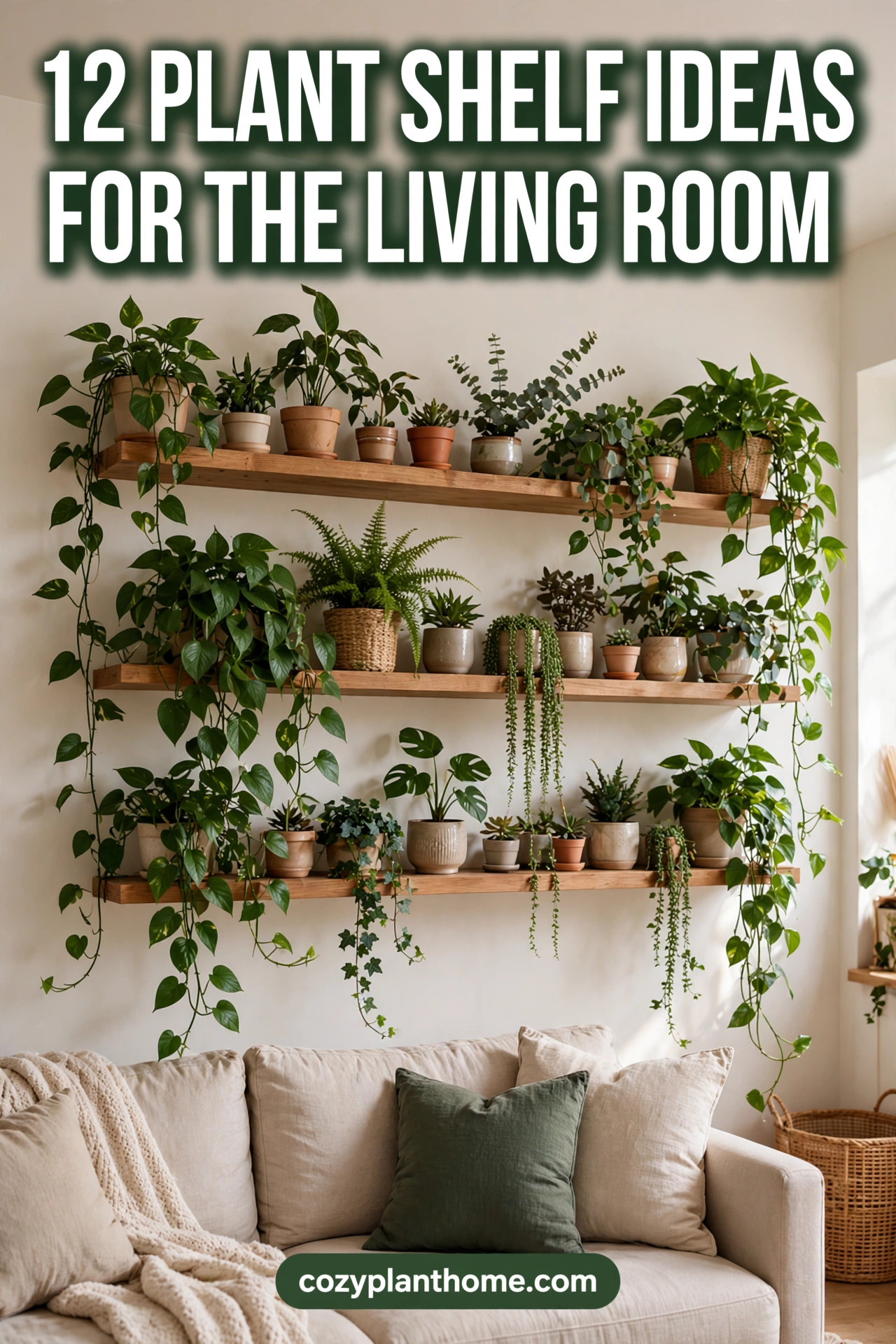 Save to Pinterest
1. The window-front shelf
A slim shelf across a window, or a glass shelf inside the window frame, puts plants in the brightest spot in the room without taking floor space.
- Use a glass or narrow slatted shelf so light still passes to the room below.
- Keep it shallow: one row of small to medium pots is the limit.
- Rotate pots a quarter turn every week or two so growth stays even.
Plants that suit it: light-hungry plants such as succulents, string of pearls, hoyas, and herbs. Plants that scorch in direct sun should sit to the side of the window.
2. Floating shelves in a blank corner
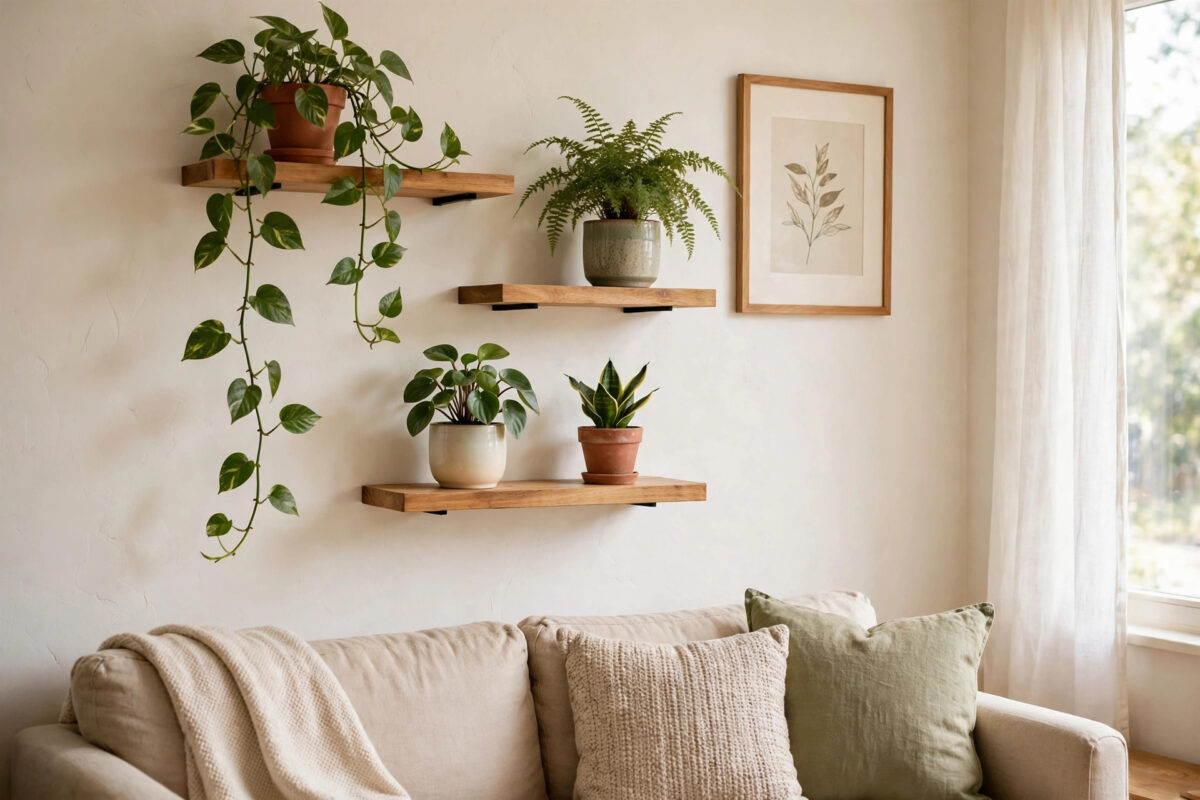
Two or three short floating shelves, staggered up a corner, turn dead space into the room’s plant display.
- Stagger the shelves rather than stacking them in a straight column; it looks better and gives tall plants room.
- Put the largest pot on the lowest shelf, where the load is easiest to support.
- Leave clearance above each pot for watering access.
Plants that suit it: upright plants below, such as a snake plant or cast iron plant, with a trailing plant on the top shelf so vines fall freely down the corner.
3. The shelf above the sofa – safely
The wall above a sofa is prime display space, and the one spot where a falling pot lands on people. It works only with the safety steps taken seriously.
- Anchor the shelf into studs, and use a shelf with a raised front lip or a discreet retaining bar.
- Use lightweight pots: plastic nursery pots inside decorative covers keep the load down.
- Train trailing vines sideways along the shelf, out of reach of anyone sitting below, instead of letting them hang over the seating.
Plants that suit it: trailing plants in light pots, and compact plants that do not need frequent watering, because every watering trip above a sofa is a spill risk.
4. Ladder shelf / leaning bookcase
A ladder shelf leans against the wall and needs no drilling beyond a safety strap at the top. It suits renters and frequent rearrangers.
- Fix the top to the wall with the strap provided; a loaded ladder shelf can tip forward.
- Load it like a pyramid: heaviest pots on the wide bottom shelf, lightest on the narrow top.
- Mix plants with books and a couple of non-plant objects so it reads as furniture, not storage.
Plants that suit it: almost anything in a small to medium pot, with a trailing plant on the deep top shelf in bright, indirect light.
5. One long picture-ledge plant row
A picture ledge is a shallow shelf with a front lip, made for leaning frames – and ideal for a single tidy row of small pots.
- Run one long ledge, or two end to end, at eye level on a blank wall.
- Use pots of similar height and one or two pot colors, and let the plants provide the variety.
- Water with a small-spout can, in place, and check for drips afterwards.
Plants that suit it: small plants with similar water needs, such as peperomias grouped together, or a row of succulents on a sunny wall.
6. Shelf with a grow light for a dark wall
A shelf with a slim LED grow light, or a grow bulb in a clamp fixture, turns a wall that never gets daylight into a working plant spot.
- Mount the light 6 to 12 inches above the plants, on a timer, for a consistent day length.
- Use a full-spectrum bulb made for plant growing, in a color that still looks pleasant in a living room.
- Water less often than at a window: soil dries more slowly away from sun and heat.
Plants that suit it: low and medium light plants such as pothos, philodendron, and cast iron plant.
Styling rules that make shelves look good
- Work in odd numbers. Groups of three or five pots look composed; even groups look paired off.
- Mix upright and trailing shapes. One trailer per shelf softens the line and makes the shelf read as a garden, not a row.
- Repeat pot colors. Two or three pot colors, repeated across the shelf, tie mixed plants into one display.
- Leave empty space. A shelf packed edge to edge looks like a stockroom; a gap between groups makes each group visible.
Best plants for shelves
Shelves favor plants that stay compact, trail neatly, or grow slowly in small pots:
- Pothos and heartleaf philodendron for trailing length.
- Peperomia and hoya for compact, tidy growth.
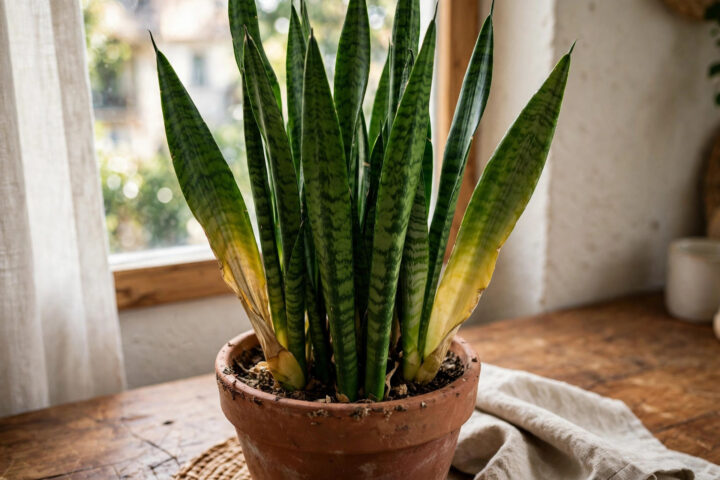
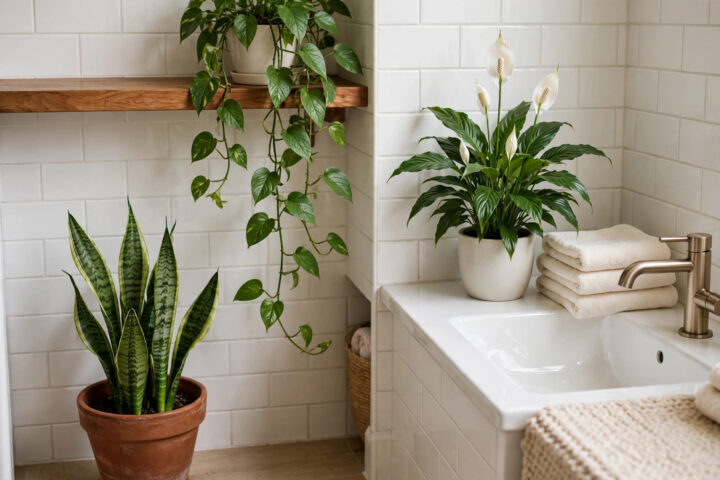
- Small snake plants and cast iron plants for upright shapes in low light.
- String of pearls and other trailing succulents for the brightest window shelves.
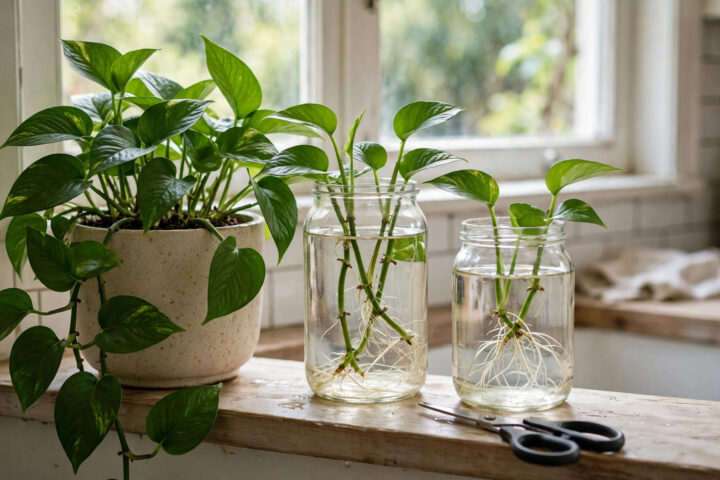
Pothos is the shelf plant most growers start with: it trails fast, roots easily, and tolerates a wide range of light.
Care Card
- Light:
- Bright indirect for best growth; tolerates low light
- Water:
- When the top of the soil is dry
- Pets:
- Toxic to cats and dogs (ASPCA)
- Difficulty:
- Easy
- Humidity:
- Average
Pet caution: the ASPCA lists pothos (Epipremnum aureum) as toxic to cats and dogs, so in a pet household it belongs on a high shelf a pet cannot reach, vines trimmed from climbing routes – or swapped for a non-toxic trailer. Check any plant against the ASPCA list, linked below, before buying.
Mistakes to avoid
- Hanging first, checking light later. A shelf fixed to a dark wall limits every plant choice afterwards.
- Skipping anchors on floating shelves. Plant weight is wet weight, and drywall alone will not hold it for long.
- Watering without a drip plan. Saucers under every pot, or watering at the sink, protect the shelf, the wall, and everything below.
- All pots the same size. One repeated size reads as storage; a mix of heights reads as a display.
- Letting trailers reach seating or the floor. Long vines get sat on, shut in doors, and chewed by pets. Trim them, or train them along the shelf.
How much weight can a floating shelf hold with plants on it?
It depends on the shelf, the brackets, and the wall. Calculate the load with wet pots, not dry ones, because a watered ceramic pot is far heavier than it feels in the shop. Anchoring into studs and staying within the bracket maker’s rated load is the safe approach.
Which plants are best for a shelf with no natural light?
No plant grows in total darkness, but a shelf with a grow light on a timer supports low and medium light plants well; pothos, heartleaf philodendron, and cast iron plant are reliable choices. Without a grow light, a truly dark shelf suits dried or artificial decor, not living plants.
How do I water plants on a high shelf?
Use a small-spout can in place, with a saucer under every pot, or carry pots to the sink and return them once drained. Sink watering is cleaner for top shelves, where spills land on everything below. A step stool makes both methods safer than reaching.
Can I put plants on a shelf above a sofa?
Yes, with the safety steps done properly: a stud-anchored shelf, a front lip or retaining bar, lightweight pots, and trailers trained along the shelf rather than over the seating. Heavy ceramic pots and thirsty plants are better placed elsewhere.
What is the easiest shelf plant for a beginner?
Pothos is the usual recommendation: it trails quickly, tolerates varied light, and droops visibly when it needs water. It is listed by the ASPCA as toxic to cats and dogs, so pet households should place it out of reach or choose a non-toxic plant instead.
Sources
- NC State Extension Gardener Plant Toolbox, Pothos (Epipremnum aureum) – https://plants.ces.ncsu.edu/plants/epipremnum-aureum/
- ASPCA, Toxic and Non-Toxic Plants List – https://www.aspca.org/pet-care/animal-poison-control/toxic-and-non-toxic-plants