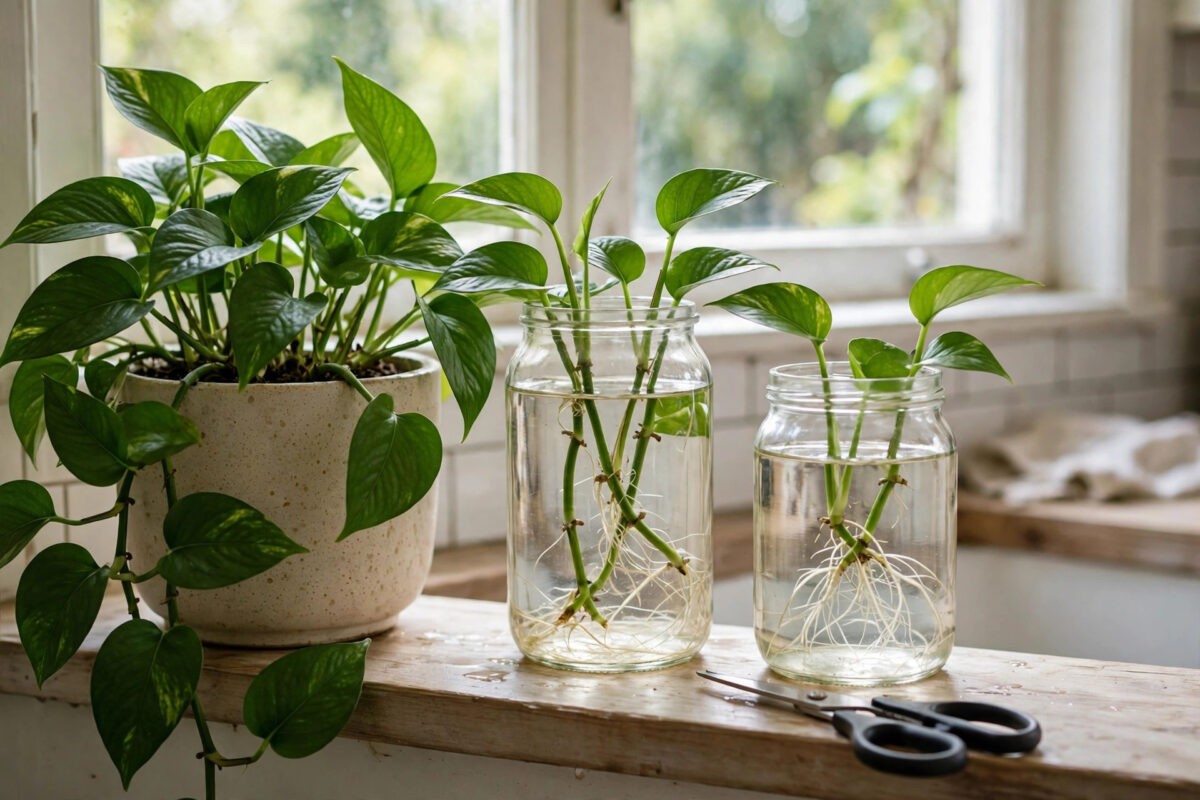
Pothos (Epipremnum aureum) is one of the easiest houseplants to multiply. A single healthy vine can become several new plants with nothing more than scissors, a jar, and water — no rooting hormone and no special equipment.
The reason it works so well is built into the plant. Pothos vines grow aerial roots at their nodes, and those nodes root readily when they sit in water. The North Carolina State Extension plant profile for pothos notes simply that its “vines easily root in water,” which is why this is the propagation method most often recommended for beginners.
This guide walks through the whole process: where to cut, how to set up the jar, when the roots are ready, and how to move a water-rooted cutting into soil without losing it.
Quick Answer
To propagate pothos in water, cut a healthy stem just below a node — the bump where a leaf meets the stem — and strip off the lower leaves. Set the cutting in room-temperature water with the nodes submerged and the leaves above the waterline. Roots typically form within a few weeks. Pot the cutting up when the roots are about 1-2 inches long, or keep it growing in water.
In This Post
Care Card
- Light:
- Bright indirect for rooting; tolerates low light
- Water:
- Change the water weekly
- Pets:
- Toxic to cats and dogs (ASPCA)
- Difficulty:
- Easy
- Humidity:
- Average
What you need
Everything on this list is basic kitchen-and-garden equipment:
- A healthy pothos plant with at least one long vine
- Clean, sharp scissors or pruning snips
- A clear glass jar or vase (clear glass lets you watch the roots)
- Room-temperature water
- A small pot and well-draining potting mix, for when the cutting is ready for soil
Clean tools matter more than fancy ones. Wipe scissor blades with rubbing alcohol before you cut, so bacteria and fungal spores are not carried into the fresh cut.
 Save to Pinterest
Step by step
Step 1: Choose a healthy vine
Pick a vine that looks vigorous: firm stem, healthy green leaves, and no yellowing, spots, or pests. A cutting taken from a struggling section usually struggles too.
Spring and summer are easiest, when the plant is actively growing, but indoor cuttings can root any time of year.
Step 2: Find the node
The node is the small brown bump on the stem where a leaf joins it. This is the part that produces roots, so every cutting needs at least one node — a piece of plain stem with no node will sit in water and eventually rot instead of rooting.
Many nodes already show a short brown aerial root nub. That is a good sign: that node is ready to grow.
Step 3: Cut just below the node
Cut the stem about a quarter inch below a node. Aim for a cutting roughly 4-6 inches long with 1-2 nodes on it.
One long vine can give you several cuttings. Work along the vine, cutting below each node, and you will have a row of jars from a single pruning session.
Step 4: Strip the lower leaves
Remove the leaves nearest the cut end so that no leaf will sit underwater. Submerged leaves rot quickly, cloud the water, and can take the whole cutting down with them.
Leave at least one or two healthy leaves at the top of the cutting. The cutting still needs them to photosynthesize while it roots.
Step 5: Place the cutting in water
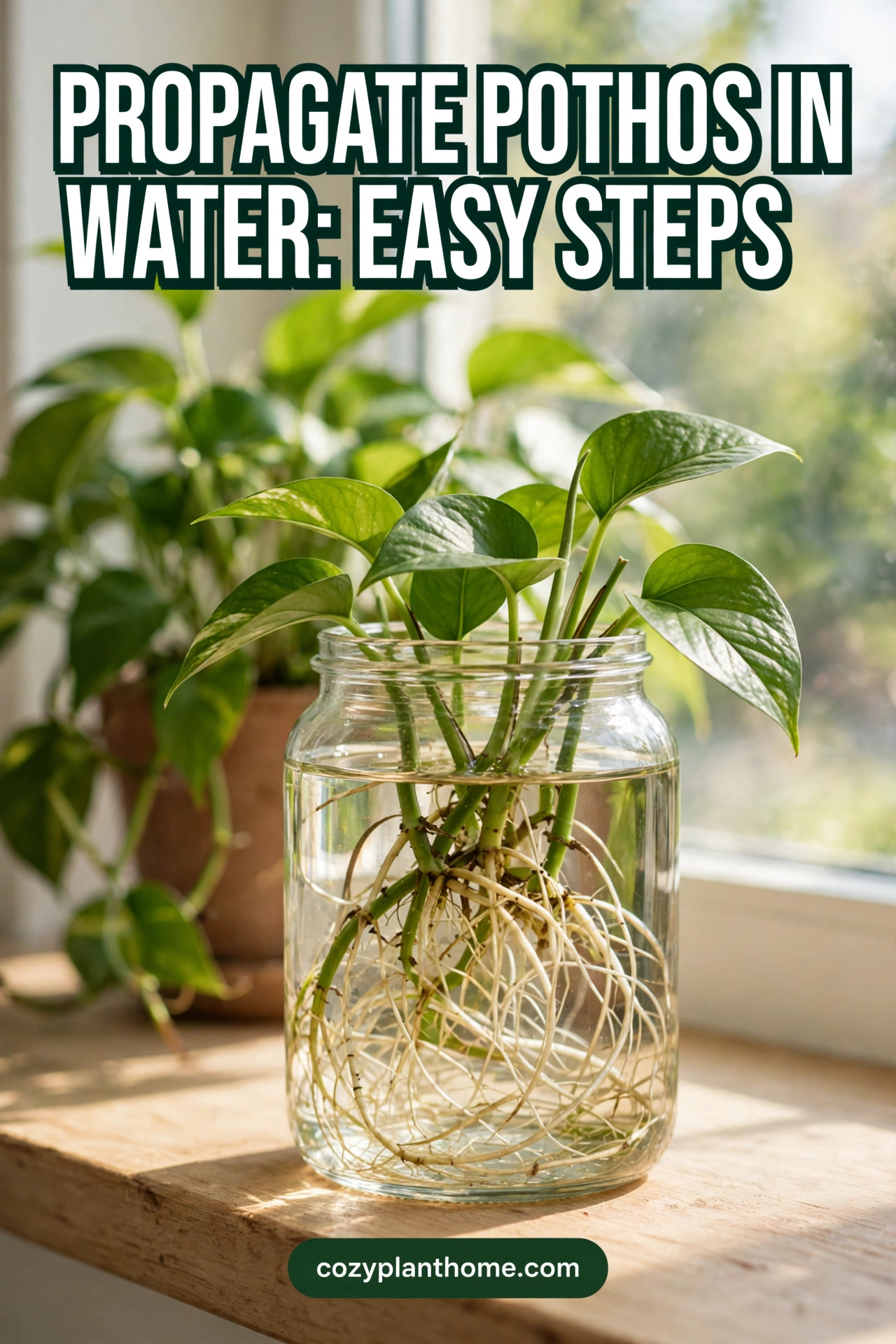
Set the cutting in the jar so the nodes are fully submerged and all leaves are above the waterline. Fill with room-temperature water — cold tap water can shock the stem.
A clear jar on a windowsill is the classic setup, and it works. Just keep it out of harsh midday sun, which heats the water and encourages algae.
Step 6: Give it bright, indirect light
Place the jar where it gets bright, indirect light. Light drives root growth, so a dim corner slows everything down.
Pothos tolerates low light once established, but cuttings root noticeably faster with more of it. Note that variegated types need reasonable light to hold their pattern — NC State Extension notes that low light can cause loss of variegation in pothos.
Step 7: Change the water weekly
Refresh the water about once a week. This replaces the oxygen roots use, washes away bacteria, and keeps the water from going cloudy or slimy.
If the water clouds up between changes, rinse the stems gently, wash the jar, and refill. Do not add fertilizer at this stage — plain water is enough until roots appear.
When are the roots ready?
Most cuttings push out white roots within a few weeks, though timing varies with light, temperature, and the season. A cutting started in a bright spot in spring usually roots faster than one started in midwinter.
The cutting is ready to pot up when the roots are about 1-2 inches long and starting to branch. Roots much longer than that adapt to soil less easily, so there is a real window.
You also do not have to pot it up at all. Pothos can live in water long-term — just refresh the water weekly and add a drop of diluted liquid fertilizer now and then, because plain water contains no nutrients.
Potting up without killing it
Roots grown in water are adapted to water. They are thinner and more brittle than soil roots, and the cutting needs a short adjustment period while it grows proper soil roots.
Pot the cutting into a small container with drainage holes and a well-draining mix, burying the roots gently. Water it in well.
For the first few weeks, keep the soil consistently moist — wetter than you would keep an established pothos. This bridges the gap while the roots adapt. Once you see new leaf growth, ease back to normal pothos care: NC State Extension advises letting the potting medium dry out between waterings, because overwatering is what leads to root rot and blackened leaf margins in this plant.
For a bushy pot, plant several cuttings together rather than a single stem.
Troubleshooting
No roots after several weeks
The most common cause is a cutting with no node in the water. Check that a node — not just bare stem — is submerged. Old, woody, slow-growing sections of vine also root reluctantly; try a fresher cutting from a greener part of the plant, and move the jar somewhere brighter.
Slimy stems or cloudy water
Slime means bacteria are building up and rot is starting. Take the cutting out, rinse the stem, and trim away any soft, brown, mushy tissue back to firm green stem with clean scissors. Wash the jar, refill with fresh water, and change the water more often.
Leaves yellowing on the cutting
A single older leaf yellowing is often just the cutting shedding what it cannot support. Several leaves yellowing at once usually points to rot at the stem (see above) or water that has gone stale. Refresh the water, check the stem for soft spots, and trim as needed.
Algae growing in the jar
Green algae is harmless to the cutting but signals lots of light hitting the water itself. Move the jar out of direct sun, switch to an opaque or tinted container, or wrap the jar in paper. Clean the jar at each water change.
A safety note for pet homes
Pothos is listed as toxic to cats and dogs by the ASPCA. The plant contains insoluble calcium oxalates, and chewing it can irritate a pet’s mouth and digestive tract.
Water propagation puts cuttings in open jars at exactly the height a curious cat can reach. Keep jars and the parent plant out of pet reach — on a high shelf or in a closed room — and check our pet-safe plant guides if you want trailing plants that are safe to keep within reach.
How long does pothos take to root in water?
Typically a few weeks. Light and temperature are the biggest factors: cuttings in bright, indirect light in spring and summer root faster than cuttings kept in dim spots or started in winter. If nothing has happened after a month, check that a node is actually submerged.
Can pothos live in water forever?
Yes, pothos can grow in water long-term. Refresh the water weekly and add a small amount of diluted liquid fertilizer occasionally, since plain water has no nutrients. Growth is usually slower than in soil, and the vines stay smaller.
Should I use rooting hormone for water propagation?
It is not needed. Pothos nodes root readily in plain water thanks to the aerial root nubs already present on the stem. Clean tools, a submerged node, bright indirect light, and weekly water changes matter far more than hormone.
Why is my cutting rotting instead of rooting?
Rot usually starts with a leaf left underwater, stale water, or a cutting with no node. Trim off all soft brown tissue back to firm stem, remove any submerged leaves, wash the jar, and restart in fresh water with the node below the waterline.
Is pothos safe to propagate in a home with cats?
The plant itself is toxic to cats and dogs according to the ASPCA, and open jars of cuttings are easy for a cat to reach. Propagate on a high shelf or in a room your pets cannot access, and never leave trimmed leaves or stem pieces where a pet can chew them.
Sources
- NC State Extension Gardener Plant Toolbox — Pothos (Epipremnum aureum): https://plants.ces.ncsu.edu/plants/epipremnum-aureum/
- ASPCA — Toxic and Non-Toxic Plants List: https://www.aspca.org/pet-care/animal-poison-control/toxic-and-non-toxic-plants